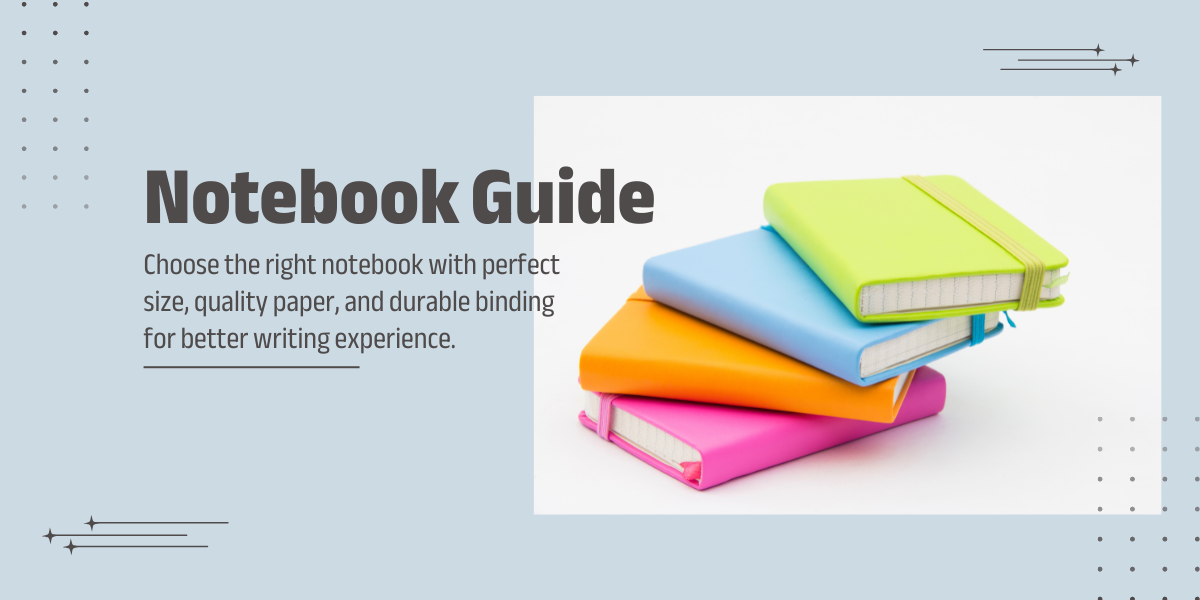
Notebook Sizes, Paper Quality and Binding Types: A Complete Beginner Guide
Choosing the right notebook may seem like a simple task, but when you look closely, there are many factors that affect your writing experience. From notebook sizes to paper quality and binding types, every detail plays an important role in how comfortable and effective your note-taking becomes.
Whether you are a student, office professional, or someone who enjoys writing daily, understanding these basics will help you select the perfect notebook for your needs. This complete guide explains everything in simple terms so you can make an informed choice.
Understanding Notebook Sizes
Notebook sizes are an important factor to consider before purchasing, as they influence portability, writing comfort, and overall usability. Larger notebooks provide more space for detailed work, while smaller ones are easier to carry. Each size serves a specific purpose, making it essential to choose according to your daily writing needs.
Common Notebook Sizes
The most widely used notebook sizes include:
- A4 Size (210 × 297 mm)
This is the standard large notebook size, commonly used in schools, colleges, and offices. It provides plenty of space for detailed notes, diagrams, and assignments. - A5 Size (148 × 210 mm)
A medium-sized notebook that is easy to carry. It is ideal for personal notes, journaling, and quick writing tasks. - A6 Size (105 × 148 mm)
A compact and portable notebook that fits easily into bags or pockets. Suitable for short notes, to-do lists, and travel use. - B5 Size
Slightly larger than A5 but smaller than A4, B5 notebooks offer a balance between portability and writing space.
How to Choose the Right Notebook Size
When selecting notebook sizes, consider your usage, purpose, portability needs, writing space, convenience, organization, and how frequently you carry it daily.
- For students, A4 notebooks are ideal for subjects that require detailed writing, diagrams, and well-structured notes
- For daily use, A5 notebooks are more convenient, lightweight, and easy to carry for regular writing tasks
- For on-the-go notes, A6 notebooks work best as they are compact, portable, and perfect for quick note-taking
- For professional use, B5 notebooks offer a balanced option with good writing space while still being easy to handle
Paper Quality in Notebooks
Paper quality in notebooks is a crucial factor that directly affects writing comfort and overall experience. A good notebook is not only about size but also about smoothness, thickness, and durability of paper for clean, consistent, and long-lasting use.
What Defines Good Paper Quality?
Several elements determine the quality of paper:
- GSM (Grams per Square Meter)
This indicates the thickness of the paper. Higher GSM means thicker and stronger paper. - Smoothness
Smooth paper allows better writing flow, especially for gel and fountain pens. - Opacity
Good quality paper prevents ink from showing through the other side.
Different Types of Paper Quality
- Low GSM (50–60 GSM)
Thin paper, commonly used in basic notebooks. Ink may bleed through. - Medium GSM (60–80 GSM)
Standard quality paper suitable for everyday writing. - High GSM (80–100+ GSM)
Premium paper that offers a smooth writing experience with minimal ink bleeding.
Why Paper Quality Matters
Choosing the right paper quality in notebooks improves your overall writing experience in multiple ways:
- Writing comfort, ensuring a smooth and effortless flow without strain
- Ink absorption, preventing smudging, bleeding, or ink spread on pages
- Durability of notes, keeping pages strong and long-lasting over time
- Overall presentation, making your notes look neat, clean, and professional
For students using ball pens, standard paper works well for daily use. However, for professionals or those using ink pens, higher GSM paper is recommended for better performance and a more refined writing experience.
Types of Notebook Binding
Binding plays a major role in how a notebook functions, affecting durability, flexibility, and ease of use. A strong binding keeps pages secure, allows smooth page turning, and ensures the notebook remains intact and convenient for long-term use.
Common Types of Notebook Binding
1. Spiral Binding
Spiral notebooks are very popular due to their flexibility and ease of use. The pages are held together with a metal or plastic coil, allowing the notebook to open completely flat or fold back, making writing more convenient.
2. Stapled Binding
Also known as center pin binding, this type uses metal staples to hold the pages together along the spine. It is lightweight, cost-effective, and commonly used for thinner notebooks meant for short-term or basic usage.
3. Perfect Binding
This type of binding is commonly used in books and premium notebooks, where the pages are glued to the spine. It offers a clean and professional look, making it suitable for formal use, though it may not open completely flat.
4. Hardcover Binding
Hardcover notebooks come with a sturdy outer cover that provides extra protection to the pages inside. They are highly durable, maintain their shape over time, and are ideal for long-term use, professional work, or important records.
Conclusion
Selecting the right notebook is more than just picking any option available. Understanding notebook sizes, paper quality in notebooks, types of notebook binding, and ruled vs unruled notebooks helps you make a smarter decision.
Sri Radha Vallab Agency whether you need a notebook for studying, working, or personal use, the right combination of size, paper, and binding can greatly improve your writing experience.
Frequently Asked Questions (FAQs)
1. Which notebook size is best for students?
A4 size is best for students as it provides enough space for detailed notes and diagrams.
2. What is the most commonly used notebook size?
A4 and A5 are the most commonly used notebook sizes for study and office work.
3. How does GSM affect notebook paper quality?
Higher GSM means thicker paper that reduces ink bleeding and improves writing smoothness.
4. Which paper quality is best for fountain pens?
High GSM paper (80–100+) is best as it prevents ink bleeding and smudging.
5. What is the difference between spiral and stapled binding?
Spiral binding allows flexible page turning while stapled binding is used for thinner notebooks.